

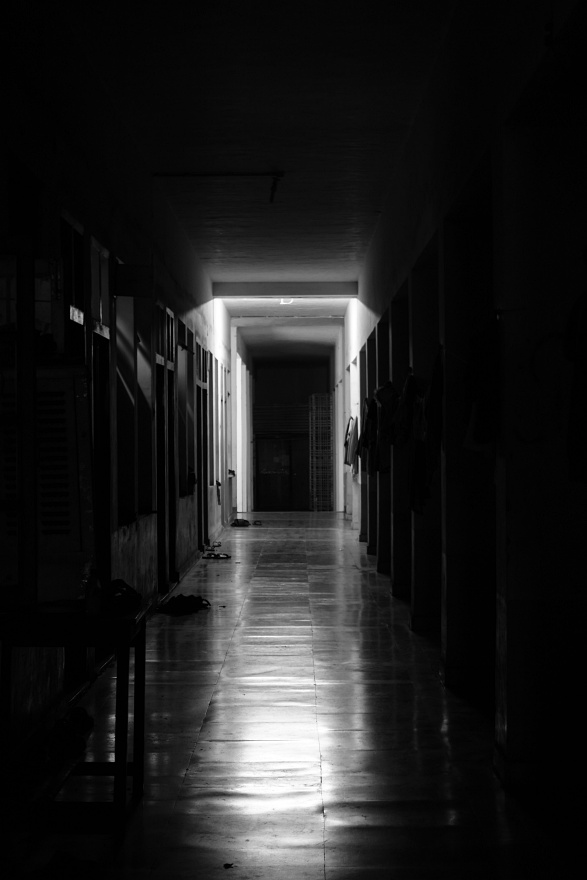
Experience is often the driving point to the source of people’s fear of death. It is the unknown. Simply telling them that we will live outside this world after we die sounds like lunacy. And those who live in the darkness of despair and unresolved suffering will shun the very thought of it to try to escape the inevitable.
And those who live in constant fear of suffering, those who have experienced traumas in their lives, has the same effect. Just because someone promises a future life in eternity free from pain and tears doesn’t make it so in the reality we live in now.
We rely on quick fixes, taking a pill, or going to talk therapy to cure all our ills. But it rarely solves the inner turmoil that plagues us. There’s something more to life than being free from internal pain and emotional agony. And we still search because we know that there is something more. And we fail to see what that something is.
But it doesn’t have to be that way…
Learning that there is more to life than what we see around us makes no sense. But much of it is because we have never truly taken the time to connect with what life actually is. We are busy with our jobs, our family and friends, entertainments and material things, but we are rarely bored; rarely left on our own to listen to our deepest thoughts.
Can we be alone? Do we have a desire to embrace time away from all the distractions this physical world brings to our attention? Is there any curiosity about what we are actually here for and how we fit into this whole world we participate in around us?
If not, why?
We’re conditioned to believe only the material world matters, viewing everything through modern science. This constant rational questioning dulls our awareness of the deeper, unexplainable aspects of existence. How can we discover our true purpose in a world that insists on such narrow views?

Moreover, we have come to believe that unless we can rationalize something and “prove it” is true, we won’t believe it. We have so bought into the idea that the only way someone can have “faith” in something is when we are convinced that it is true by reasoned arguments and fact checking data.
But is that where faith in anything actually lies? If so, where, then, is hope? Especially if we have all the answers solved for us in explanations and rational thought.
And if all we witness around us is all that matters, upon what are we relying for accuracy? How often have the accuracies and “proofs” of science be rescinded and proven false decades or even centuries later, often with diametrically opposed results? There is really no stability in our own certitude.
Slowly the light begins to shine in our intellectual darkness when one realizes that we don’t have all the answers. We have, as a matter of course, more questions after discoveries, but no solutions, no substantial conclusions after researching what has already been revealed by man’s intellectual prowess.
Our supposed “truths” are not solutions. They raise endless questions, revealing we haven’t found final answers. Discovery is limitless—the more we learn, the more there is to learn.
So where do we go from here?
We seek something to satisfy our inner longing. Yet, we seem to look for that answer in the wrong way. And is because we continue to depend upon ourselves to find the answers.

We can only be as good as our teacher, and if that teacher is ourselves, we soon realize we don’t have all the answers. The same applies to AI, which learns and summarizes from human knowledge but doesn’t possess complete understanding.
In order to find the solution, we must first understand what is true. Truth, with a capital T, isn’t subjective. It is unchanging. And in that Truth lies the key to unlocking the answers we are looking for beyond what we envision around us.
If we don’t grasp what reality truly is, how could be ever hope to overcome the darkness that is overshadowing our world today? And it is a frightening cloud that looms overhead.
Changing paradigms…
Let’s take an example of what I mean.
Three people are sitting in a room. All have had the same experience dissecting a frog in the biology class that day.

The first student is fascinated by uncovering the frog’s tissue layers, appreciating how its bones, muscles, and eyes fit together. His curiosity leads him to write a thesis on the subject, which he publishes in the school yearbook to share his insights.
The second student refuses to dissect the frog, viewing it as a waste of life and unnecessary, given that frogs have been dissected before. She protests the exercise, citing concerns about inhumane treatment of animals.
The third student approaches the dissection with indifference, occasionally provoking squeamish classmates by popping out an eyeball. He sees little point in the process, using it instead as a chance to discomfort others for his amusement.
They share their perspectives, discussing likes and dislikes, allowing insight into each other’s viewpoints. This highlights that each student approaches the exercise from a uniquely shaped worldview influenced by their experiences and outlooks.
Like three different people looking at three different sides of the same apple, or the three blind men trying to describe an elephant based on their position along the animal’s anatomy, it is unlikely to get any of them to relay their findings in the same light. Was any one of them “right” in their perspectives? Or were each of them different because of the experiential knowledge of life pertaining to them?
What if the first student highlights the experiment’s benefits, broadening the second’s perspective? And what if the third, driven by entertainment, is shown how it upsets others and a personal story is shared with them about the cruel side of hurting or killing innocent creatures? Would he then start to understand and become more sensitive to those harmed by his pleasure?

A paradigm shift in how we approach life is unfolding in our culture. The emptiness inside isn’t satisfied by advertising’s hollow promises. Bigger paychecks merely deepen the void, revealing that money cannot buy happiness or fulfillment. Neither eastern mysticism nor the transcendental meditation alone can fill the longing for true completeness.
We live in a world that refuses to accept a God beyond themselves – the “God is dead” philosophy taught to us since the 1960’s is finding its beliefs crumbling beneath the weight of reality. Man isn’t meant to live only in the physical world. His core humanity reaches beyond the heights of this life into a realm that is, as yet, unknown to those still in this mortal life.
So is there light beyond the darkness?
Yes. But this insight emerges only when we replace the false belief in dismissing the unknowable with an acceptance that unlocks a larger understanding. Our current societal beliefs are crumbling; the stability we seek is gone. We can know the “what”, but not the reason, for existence. We can control or destroy our surroundings, including ourselves, yet remain blind to why we are here.

Modern science and atheism cannot explain our purpose, function, or the perfect interconnectivity of everything. They fail to illuminate life, death, or the unseen beyond. They hold no answers—only known data—and cannot explain the interconnected systems holding everything in harmony. Our modern medical system highlights this reality by failing to recognize the innate intelligence of the human body, which can heal itself, signal issues through symptoms, and demonstrate resilience when injured.
So where do we find this hope? Much in the answer to this question comes from our approach to understanding life. And it begins with abandoning the idea that we have to explain everything.
We will never know all that we see. We will never fully understand the world around us, let alone the purpose of our own existence.
Once we let go with the need to philosophize existence of anything, we will begin to see the world through a different set of glasses. Instead of trying to analyze what we see, we need to discover what is is.
You cannot understand a frog by dissecting it. It gives data only – the parts and pieces of a physical structure, but nothing about its “frogness”, as Plato would say – its essence. We can observe and document its mating habits and ideal living conditions, its behaviors and the nutritional makeup of its diet, but will we truly know what a frog is?
Define yourself. Do it without telling us your age, gender, sexual orientation, skills, what you look like, your personal preferences in food, clothing, etc. Have a friend or family member try to describe you without mentioning externals. Who really are you? Can you define yourself as something other than by race, nationality, religion, or what title you hold in society?
It’s hard. It’s harder when we are limited to seeing the world through the lens of facts, data, philosophical dissertations. Without our Western mindset, we in the West are lost.

But what if we went East?
The Western mind tends to embrace and prioritize individualism and logical approaches to understand the world around it. It cannot function without certainty, eschewing the mystical and unexplainable, argument over intuition, rules and defined principles of behavior. It explores nature separately to study that which is outside the human mind as distinct from the whole. This includes the study to control or improve the body in which the mind dwells rather than recognizing the integrated unity of mind and body.
The Eastern perspective sees all life as interconnected, where one person’s actions influence others. The world is unified by a shared creative force. Purpose isn’t about skill or income but about becoming a better, more integrated human being—improving oneself not for personal gain, but to support the whole. It values experience and transformation over rules and critical thinking, emphasizing spirituality over rational debate. The East is boundless, while the West remains confined to the immediate physical world.

Father Deacon Ezra Ham of St Elijah Orthodox Church in Oklahoma City, Oklahoma puts it this way:
In summary:
If a Westerner wants to define what a tree is, he will dismember and tear apart a living tree, discovering its physical make-up, history, and data gathering. He will leave behind his notes and sawdust, and a dead tree.

But if an Easterner wants to discover what a tree is, he will first take a seed and plant it. He will watch it grow, learn what it needs for food, water, and the best environment to promote life. He will learn from it, live with it, interact with it using its strong branches for swings and climbing, hold celebrations and even be buried beneath it. He will live with it and alongside it without destroying it. And it will continue to live for the sake of generations to come.
So when we desire to seek to find light in the midst of our spiritually darkened world, we need not seek any farther than to look outside ourselves. In doing so, fear of struggles and the ever growing expression of humanity without connection to its Originator – the evil that lurks around every corner of our existence that is growing exponentially, we will find the answer we are looking for.
But first, we must let go of our preconceived notions about how to approach life. For the key to embracing death and loosing its stranglehold of fear is to embrace life with a different perspective. Only then will the light will truly begin to shine in the midst of the darkness.

We love to hear your input! Please leave a comment.