

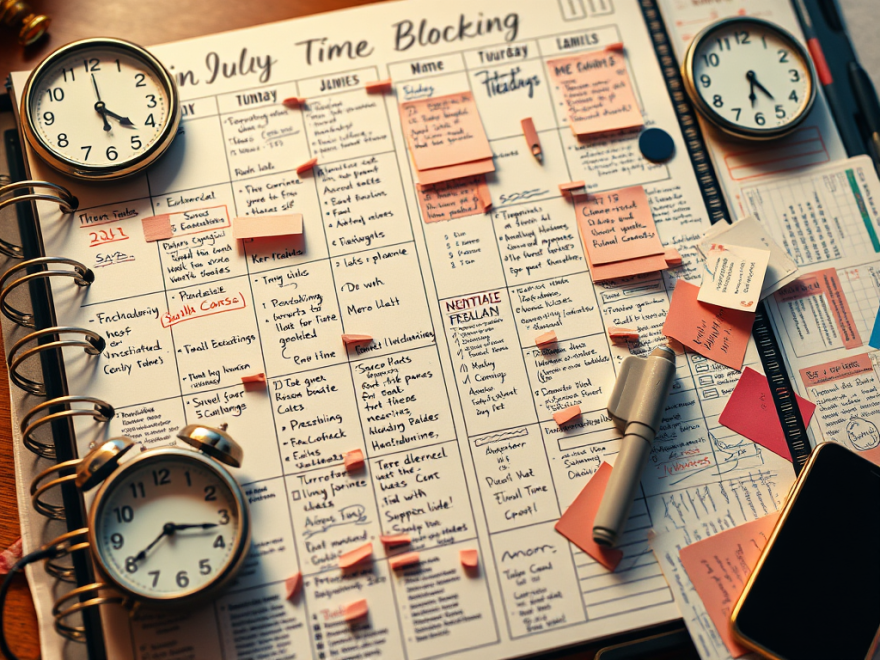
Timeblocking. The art of squeezing all the doable tasks into a tight space of time in order to reduce distractions and achieve your ultimate goal.
For procrastinators and people who get distracted easily, the ideas of Timeblocking and Timeboxing are more than a necessity.
They are mandatory if anything is ever to get done.
Timeboxing…
This one is awesome if you have a need to do tasks that are unchangeable and must be limited in scope. Such as getting out of bed in the morning.
But the problem with this method is that it doesn’t work well for goal setting.
[T]he problem with this method is that it doesn’t work well for goal setting.
If you have a goal to get a business started, for example, giving yourself only 60 minutes to work on the marketing strategy two times per day with a small break in between doesn’t give the flexibility of “getting in the zone”.
I don’t know about you, but if I am working on something, it hardly ever fits into a set time slot.
And I end up underestimating just how long a particular step is going to be anyway, so the time limit only adds to the overall stress of doing anything.
Like, every time.
So what are the options?
Timeblocking
The art of Timeblocking is a concept that is as old as calendars. But Benjamin Franklin is credited as being one of the first to adopt the system.

By breaking a goal into smaller tasks, or steps, it is fairly easy to take each one and set aside a block of time in order to accomplish them.
That is the beauty of timeblocking.
Each day, you set aside a chunk of time to work on a category of choice. Like Benjamin Franklin’s “Work”.
Then add a task, or step, that has been predetermined to reach your final goal. If it isn’t completed within that allotted time period, move it to the next day.
This method keeps the production constrained, and also limits the amount of time dedicated to that task. It allows the chance to focus fully on that single step at hand instead of the entire project, and theoretically eliminates time for other distractions.
The time blocked off is only for working on a step (or two) that is in your plan.
Unless you have kids. Kids are always a distraction. And they don’t seem to care if you have time set aside to work on your own projects.
Ever.
So here’s the cautionary part…
No matter which option is chosen, be realistic about how long you think it will take to accomplish the given task.
For example, how long do you think realistically it will take to clean and organize your bedroom? (Don’t even think about your office space…that will take three times as long!)
If you think it will only take an hour, add another hour to the timeblock. The joy of doing this is that you might be finding yourself challenged to finish early and give yourself the rest of the time to…have fun!
[B]e realistic about how long you think it will take to accomplish the given task.
But if you’re like me, that “hour” usually ends up taking the entire day. I tend to get caught up in the details of putting everything back together.
Or if the day starts out already behind, you can pretty much guarantee that your best laid plans will be shot completely. Guaranteed.
So plan for a worse case scenario and you’ll get more done that you planned.
Solution?
Instead of choosing to do two or three big tasks per day, pick one. Just one. Especially on days that you can’t seem to get any traction.
If you get that task done, great! If not, move the rest to the next day and don’t stress about it.
Getting things done is fine. But getting things done at the cost of stressing out isn’t.
And if you have more time, add a secondary task.
But don’t overdo!
If you don’t want to burn out, use the Timeblock method as an incentive to accomplish that task – a minor deadline goal. Getting things done is fine. But getting things done at the cost of stressing out isn’t.
So start slowly. Give yourself grace.
And then move on to the next task.
And if you don’t get something done, move the task to the next day to finish up.
Days vary…
Energy levels, activities, emergencies, physical health all change from day to day. What seemed like a great idea yesterday might not seem like one today. Maybe you stayed up all night with a sick child (or pet). Maybe the weather sent you to the tornado three times in the middle of the night. Or you somehow got sick and feel like a truck ran you over somewhere around midnight.

In any case, don’t fret so much about what was left undone. Just pick up where you left off, and set your tasks for the day according to your energy levels.
That’s the beauty of Timeblocking. You’re not locked in to the specific task to be finished within any given time period. You have an entire week – or month – or quarter – to complete it in order for you to move the needle toward reaching your goal.
A tale of timeboxing…
I used to work for a large big box store corporate center. The projects were large and the time constraints were equally as large.
Setting daily timeboxing to do each task daily was unrealistic and unachievable. But it was necessary, in a sense, in order to meet the arbitrary deadlines imposed by management.
At the end of each day, I would go home utterly exhausted and frustrated. Tasks left undone because of a lack of time became the next day’s chore. Constant interruptions from unplanned meetings, management changes to the project goals, software glitches and computer failures all added to the stress of reaching the unreachable every day.
Setting daily timeboxing to do each task daily was unrealistic and unachievable.
Add to that the coworkers who never did their part of the tasks to complete the work just made it harder to see any reason for blocking off time to do anything but leave for home.
And did I mention traffic? Just driving to and from an office added to the time boxing inefficiency as well. One never knew when that day someone would decide to have a wreck and block the very road you needed to get to work. Late. Into the box of time set aside to meet your daily deadline.
So, reality check.
Timeblocking gives more flexibility to accomplish tasks every day. It doesn’t constrain the work being done. It just set aside the time portioned out to do something from your list of “to do’s” for the week.
No matter which type of time management system you decide to use, just be realistic. Unless you like regularly having nervous breakdowns and waking up every morning at 3am worried about what you didn’t finish yesterday.
Limit your goals for the week to only three tasks. No more.
Then break down those three tasks into smaller steps.

Put each step down during the course of the following weeks, starting with the first step.
Don’t fill in your week with all the tasks!! That must be done each night before you shut everything down, or early in the morning before you start your day.
Where did you leave off? Which steps are left? Which one or ones will be able to be accomplished today? Realistically…
Give a lot of wiggle room for those inevitable emergencies, meeting, family distractions that will take over your allotted time. This is life. And life is filled with unexpected events. So plan accordingly.
Then don’t forget the most important things…
Downtime. Play time. Creative time.
I’m not talking about which TV show to watch to dull the stress of the day.
I’m talking about DEstressing.
Spending time in solitude. Prayer. Reading a good book. Listening to soft music. Playing with the kids or pets. Painting or other creative outlet.
Not sitting idle in front of videos trying to forget what got you stressed in the first place.
In the words of one of Father Hopko’s famous “55 Maxims“, number 26:
Do your work, then forget it.
In other words, don’t take your work with you when you leave work. Even if “leaving work” means turning off your computer for the day from a remote job, or working on a project you are doing around the house.
Leave work where you left it. And take up the rest of your day spending it living your real life.
Those are the moments that no work should interfere with. Those are the moments you will never get back.
Don’t let those things creep into your personal life.
Spend your time wisely.
Leave work where you left it. And take up the rest of your day spending it living your real life.
And prudently.
The work may not be as complete as you’d like it to be, but if you have a plan in place, it will get done. On time. Every time.
Then relax. Do physical activities to unwind and give your body a chance to, also, relax.
You won’t gain anything by worrying about not meeting some arbitrary time constraint. Life is too short for that.
You need to take care of yourself or you’ll be no good to anyone – including yourself.
No work will ever be as important as you.